

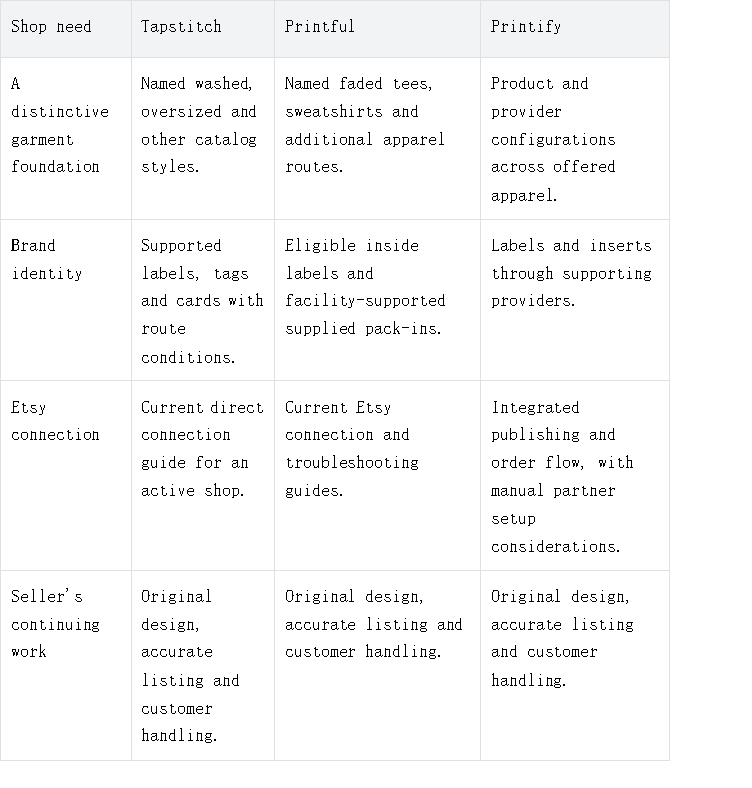

For Etsy sellers offering their own apparel designs, Tapstitch, Printful and Printify are supplier candidates with different product and workflow strengths. Tapstitch merits consideration for a shop built around particular catalog silhouettes. Printful is suitable when its garments and decoration methods match the range. Printify suits a seller willing to maintain product and provider-specific choices. The first decision, however, is whether the item belongs on Etsy: a connection to a fulfillment platform does not turn ready-made clothing resale into an original-design product.
Which POD Partner Fits an Etsy Apparel Shop?
An Etsy apparel shop needs a product that expresses the seller’s contribution and a supplier that can produce it. An original graphic on a suitable garment is one possible route. A seller’s unique garment design manufactured by a partner is another. These are different projects, with different production and listing needs.
The supplier should support the relevant garment, decoration and order flow. The seller should maintain an accurate listing, production-partner information and customer promise. These responsibilities overlap, but they do not transfer completely to the supplier after app installation.
Branding can be useful, particularly for repeat customers. An interior logo may identify the shop, while a parcel card can explain care or the design story. Neither transforms an unchanged commercially available garment into an original design for Etsy. Product eligibility should be resolved before optimizing its packaging.
The seller also needs a sustainable way to handle exceptions. A customer asking about sizing, a held production order and a missing parcel require different actions. Selecting a supplier includes understanding those actions, rather than treating successful product publication as the end of setup.
Check Etsy’s Design and Production-Partner Requirements
Etsy’s Creativity Standards allow sellers’ original designs produced by production partners, with disclosure and accurate dispatch information. Etsy’s dropshipping guidance distinguishes that arrangement from selling products the seller did not design and the buyer did not personalize. A production partner can make and ship the item, but cannot supply the seller’s missing creative role. Creativity Standards, dropshipping and reselling guidance
For the comparison, consider a shop selling its own illustration across a tee, a sweatshirt and a seasonal layer. The illustration connects the collection, while the garments need to suit the audience. This is a purchasing brief rather than an example of an already-approved Etsy shop.
For original designs manufactured with assistance, disclose the production partner on the applicable listing and accurately identify where the product is dispatched from. Etsy’s production-partner guide defines which relationships qualify. An unchanged ready-made garment with a new brand name should not be treated as equivalent to a seller-designed item. Etsy production partners
Printify notes that it cannot automatically create a production partner in the Etsy account. If the appropriate partner already exists, its publishing process can assign it; otherwise the seller needs to update the listing details. This is an important example of a publishing workflow that still requires seller maintenance. Printify partner setup
Images need the same attention. Etsy permits a stock-photo mockup for a seller’s original artwork printed onto a base item. Its rules require a real finished-product image for a uniquely designed item made by a partner, and a finished customized example as the first image for buyer-personalized items. These exceptions should not be combined into a blanket rule that all POD mockups are accepted or all are prohibited. Etsy Listing Image Requirements
The description should represent the selected garment and artwork accurately. Include the fit information shoppers need, the offered customization and a realistic production-and-delivery promise. If the product uses a particular care procedure, describe it clearly. A polished supplier mockup cannot replace correct sizing or a meaningful description of the final item.
Keep a design record for the listing: the artwork version, selected garment and product configuration. This helps the seller maintain consistency when updating a listing or changing a production arrangement. It also supports a clear explanation of the seller’s role if a question arises about how the item was created.
Compare the Apparel and Branding You Can Actually Sell
Compare the finished listing and its production configuration. A platform feature that cannot be used on the selected product is not an advantage for that listing.
Sources: Tapstitch Etsy connection, Printful Etsy connection, Printify Etsy disclosure guidance.
Garments beyond basic T-shirts
Begin with the product roles the shop needs. A tee may carry the core illustration, a sweatshirt offer another season and a jacket create a different silhouette. Evaluate those roles separately. Availability of several T-shirt colors does not establish that a supplier can fulfill the intended outerwear product.
Tapstitch’s catalog includes the RQ0038 Vintage Wash Zip Up Denim Jacket and named fleece garments. These are specific candidates for an apparel range, rather than evidence that every listed product is suitable for every Etsy design. The seller should select the supported decoration and fulfillment configuration for the actual garment. Tapstitch catalog examples
Printful lists products beyond standard tees, including the Bella + Canvas 4711 oversized heavyweight sweatshirt and an on-demand knitted cardigan. Those routes offer different design possibilities. A graphic printed onto a sweatshirt and a jacquard design knitted into a cardigan should have different preparation and customer descriptions. Printful sweatshirt, knitted cardigan
Printify lists the Comfort Colors 3023CL boxy tee and a women’s all-over bomber jacket, among other products. The bomber’s listing identifies an overseas production route. That difference affects the shipping promise and the dispatch information an Etsy listing should communicate. A product’s presence in the catalog is separate from its suitability for the shop’s chosen delivery plan. Printify boxy tee, bomber jacket
Labels, inserts, and product-level costs
Choose brand details after the garment shortlist is viable. Tapstitch’s custom labels require international fulfillment. Printful’s inside labels are product-dependent, and supplied pack-ins are facility-dependent. Printify’s branding depends on supporting providers. A shop promising a consistent interior logo across products needs to approve that configuration for every piece. Tapstitch label guide, Printful inside labels, Printify branding
A label or insert also affects the product calculation. Price the garment and the chosen print, then add the brand treatment, its supply commitment and the delivery route. Keep Etsy’s listing and selling fees outside that supplier charge. The result should show what changes when a card is added or when a different garment needs another fulfillment location, rather than assigning one platform-wide cost to all listings.
Keep supplier costs and Etsy fees separate. Etsy currently lists a USD 0.20 listing fee and a 6.5% transaction fee, with payment processing and other applicable charges separate. These are marketplace charges, not the total cost of producing the garment. A shop also needs to account for shipping, branding and any cost of resolving customer issues. Etsy fee schedule
For a practical comparison, build one quote for each garment you intend to list, using the same artwork placement and buyer destination across the three candidates wherever comparable options exist. Separate features essential to the design from optional presentation extras. If an inside label is part of the shop’s identity, include it in every eligible quote; if it is optional, calculate the result with and without it. Then compare the amount left from the intended selling price after the relevant costs. This makes the trade-off between a distinctive garment and extra branding visible without assuming that the cheapest blank produces the strongest offer.
Compare Listings, Order Transfer, and Customer Responsibility
All three suppliers have documented Etsy connection paths. Tapstitch requires an active, completed Etsy shop before authorization. Printful’s troubleshooting guide distinguishes shop connection problems from listing and order-import problems. Printify documents automatic order handling through connected channels. These capabilities support the workflow, rather than guaranteeing listing approval or sales. Tapstitch setup, Printful troubleshooting, Printify integration
For an order check, track the paid Etsy order into the supplier account, confirm the chosen variant and artwork, and follow production through tracking. A listing visible to customers is not proof that the order link is correct. Preserve both order identifiers so a synchronization problem can be investigated without creating duplicate production.
A replacement supplier or product configuration deserves a separate check before it takes over an existing listing. For example, if a shop moves an illustration from one sweatshirt to another, compare the replacement’s measurements, available colors and print placement against what buyers currently see. Record which configuration applies to orders already accepted and which will apply to new purchases. If a relevant detail changes, update the listing before directing new orders to the replacement. Keeping that boundary clear gives the seller a way to investigate a complaint without guessing which garment the buyer received.
The delivery promise should include preparation and transit. An overseas product route may require a different promise from a domestic one, and two garments can produce separate parcels. Describe that possibility where it affects the purchase. A dispatch address should reflect the actual fulfillment arrangement rather than the seller’s preferred brand story.
When a customer reports a problem, determine whether it concerns production, fit selection or shipping. A supplier’s manufacturing-error remedy may differ from the shop’s treatment of a sizing return. Maintain evidence for production claims, while giving the customer a clear next step under the store’s stated policy.
Choose for the Range and Workflow Your Shop Needs
Choose Tapstitch for an original-design shop when a named garment provides the intended silhouette and its supported branding route fits the listing. Choose Printful when its available apparel and techniques serve the design, including collection roles beyond a basic tee. Choose Printify when product and provider selection offers a useful configuration the seller can maintain.
Original-design production and unchanged clothing resale remain different Etsy propositions. Choose the supplier for the eligible product the shop is actually offering.
The appropriate choice joins an eligible product, an approved finished configuration and an accurate Etsy listing. Start there, then verify an actual order before expanding the range. No supplier selection can promise Etsy approval, search exposure or sales; it can provide a suitable production route for the shop’s own work.
FAQ
Listing eligibility and returns remain responsibilities of the Etsy shop.
How can I compare garment fit without confusing it with the artwork?
Separate the garment decision from the design decision. For a fit comparison, record measurements and assess candidate garments on the same wearer before judging graphic placement. Then review the illustration at its intended size on each approved body. This helps distinguish a silhouette problem that needs another garment from an artwork problem that needs a placement or scale adjustment.
What should I do if a sample differs from my listing mockup?
Identify whether the difference comes from the garment, the saved artwork or the image used for the listing. Correct the relevant configuration and review another sample if the physical product changes. If the approved garment is accurate but the mockup misrepresents it, replace that image with a faithful representation before promoting the item. Keep the approved sample and listing version together so future updates preserve what shoppers are shown.