

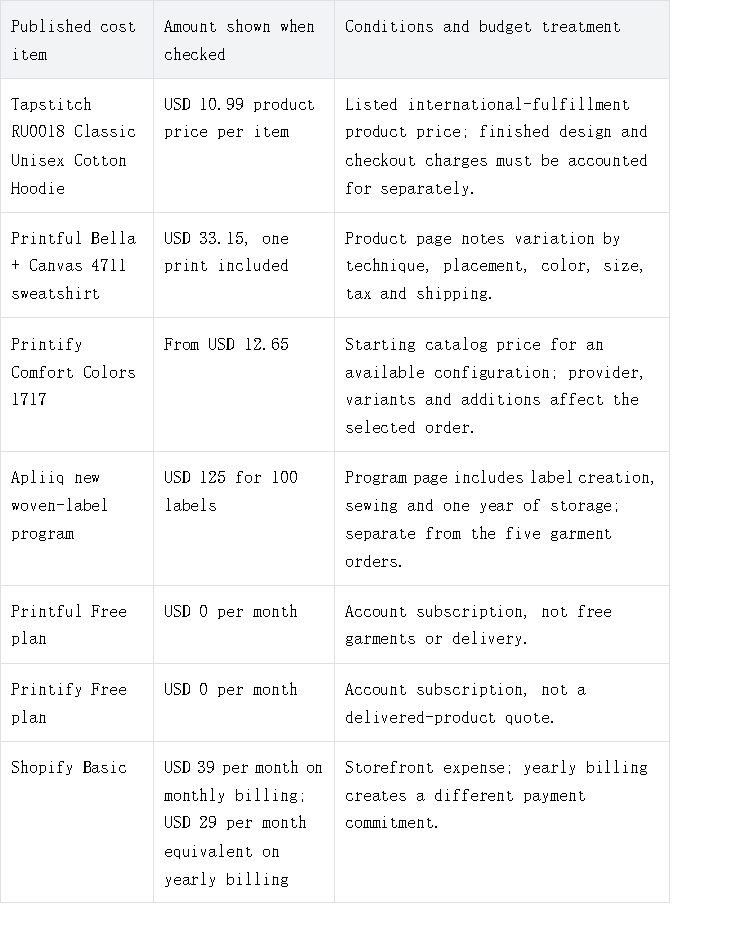

Launching five clothing products requires a budget for finished evaluation pieces, the store, essential branding and the first customer orders. Tapstitch, Printful, Printify and Apliiq can each be considered for a low-commitment launch, but their public entry prices do not establish a comparable total for the same capsule. Tapstitch is a candidate when its selected garments meet the brief without unwanted stock commitments. Printful and Printify offer free account plans alongside paid production. Apliiq deserves consideration when its branding services justify their separate supply commitments. The economical choice is the complete supported configuration, rather than the smallest catalog price.
Which Company Fits a Low-Upfront-Cost Five-Product Launch?
Keep the launch decision attached to the money required before usable sales receipts arrive. A free supplier account removes the account-subscription charge. A normal single-item purchase can reduce finished-stock commitment, while stocked labels or supplied packaging can add a separate advance purchase.
For this five-product comparison, the sensible starting plan is the smallest assortment that preserves the brand’s essential garment and decoration requirements. Choose Tapstitch for a matching catalog-led capsule, Printful for its supported product and technique combination, Printify for a manageable provider configuration, or Apliiq for a branding program that justifies its supply purchase. Then cost that precise plan rather than attaching a platform’s lowest headline price to every piece.
Working capital belongs alongside those groups. A supplier can charge for production while sales-channel receipts are still awaiting payout. A founder should budget for that gap without labeling the money a platform fee. It is cash needed to operate, even when it will later be replenished by sales.
Set a clear comparison boundary. The calculations here concern sourcing and store operation, not a complete business budget. Photography, artwork, promotion, incorporation and other business expenses should be added when relevant. Excluding those expenses from the supplier comparison does not mean they are free.
Define the Same Five Products and Cost Assumptions
Use one comparison brief for all four suppliers: a cotton graphic tee, a long-sleeve top, a crewneck sweatshirt, a hoodie and a pair of casual pants. The intended customer is in the United States. The initial evaluation quantity is one finished piece of each, in a selected reference size and color, with a common original design and an interior brand mark where supported.
This is a hypothetical capsule, not a bundle any supplier promises to provide. Each product has a role: the tee introduces the design, the long sleeve adds a layer, the crewneck and hoodie extend the seasonal offer, and the pants complete the outfit. If one supplier cannot support an essential piece or branding treatment, replacing it changes the brief and should be recorded as a different launch option.
Distinguish five products from five units of inventory. A brand can list five products while producing customer orders individually. It still needs evaluation pieces and may need additional sizes for fit approval or photography. Buying one of each is a starting evaluation quantity, rather than a guarantee that the entire range has been validated.
The launch budget should contain three separate groups. First are purchases needed before selling: evaluation orders, setup work and essential branding supplies. Second are recurring expenses such as the storefront and optional account plans. Third are charges triggered by customer orders: production, shipping and supported branding additions.
Build a Cost Breakdown for Each Platform
A comparable quote needs the same destination, quantity, decoration scope and account plan. If a listed price already includes a print, do not add that print twice. If it is a blank price, do not treat it as a finished decorated order.
The following USD figures were checked on October 14, 2026, for a US-oriented comparison. They illustrate different cost categories and are not competing quotes for an identical five-piece collection.
Sources: Tapstitch hoodie, Printful sweatshirt, Printify tee, Printful plans, Printify plans, Shopify pricing, Apliiq current woven-label program.
Trial purchases, decoration, and brand components
For each of the five selected products, record the actual finished evaluation charge. The record should identify model, variant, technique, print placements and interior branding. A similar product name is insufficient when one quotation is for a heavier body or a different decoration method.
Tapstitch’s FAQ describes trying a garment through a normal one-item order. Printful’s sample route depends on eligible account conditions and allowance. Printify states that sample orders use regular pricing without a separate sample discount. These arrangements affect the evaluation budget, but cannot be reduced to an assumption that every platform provides five discounted pieces immediately. Tapstitch FAQ, Printful samples, Printify samples
Use the sample configuration to test the final product promise. An undecorated hoodie cannot settle whether the planned graphic is well positioned. A tee without its essential interior identity cannot approve the branded version. If a first order leads to design revision, include a follow-up evaluation purchase in the launch plan.
Branding can create costs with a different quantity basis. Apliiq’s woven-label program requires an initial 100-label run and describes a preparation period. That is a purchase of label inventory, not 100 garments. A brand choosing that route should put the initial purchase into startup cash, account for any separately charged handling, and avoid charging sewing twice when it is included in the program. Apliiq woven-label program
The appropriate choice may be a simpler first release. If the interior brand mark is optional, the founder can defer a supply-heavy program. If it defines the product, removing it creates a different brief. Compare those two launch plans openly rather than announcing savings for a product that no longer meets the intended requirement.
Shipping, store fees, and order-payment timing
Shipping must follow the selected products and fulfillment arrangements. Five evaluation garments do not necessarily form one shipment. A cart containing different product routes can create separate transport charges, and a provider network can make the chosen combination important. Use the complete basket and destination when determining the total.
Tapstitch’s shipping page separates transit from production and uses route-dependent estimates. Apliiq’s supplied packaging programs involve storage and picking charges. Printful’s supplied pack-ins depend on a supporting facility, while Printify’s inserts depend on supporting providers. These arrangements affect both cash and the customer presentation. Tapstitch shipping, Apliiq warehouse pricing, Printful pack-ins, Printify branding
Storefront spending should use the billing period actually chosen. A yearly plan’s monthly equivalent is useful for comparing ongoing expense, but it should not be entered as one month’s cash outlay if the year is charged upfront. Introductory offers likewise belong to a separate temporary scenario, rather than to the normal operating budget.
Optional supplier subscriptions need a decision rule. Compare the incremental subscription cost with savings on the products the brand actually sells over that period. Discounts on unrelated items do not help this capsule. For a small launch with uncertain volume, keeping a free account plan can preserve cash until there is evidence supporting an upgrade.
Tax and payment charges should remain visible in the final order and storefront calculation. Their treatment depends on the actual purchase and business setup. Do not fill them with an assumed zero or combine buyer-collected taxes with the brand’s usable sales revenue.
Calculate Comparable Totals and Test the Budget Variables
Use these relationships for each supplier’s selected configuration:
Pre-sale product cash = finished evaluation orders + evaluation shipping + essential branding-supply purchases + required setup charges.
Launch cash requirement = pre-sale product cash + storefront cash due + operating cash buffer + planned contingency.
Per-order supplier charge = production and decoration + order-level branding + shipping + applicable supplier taxes or handling.
The following example demonstrates the method. It is an invented planning scenario, not a quote from any of the four suppliers. Assume finished evaluation charges of USD 20, 25, 30, 35 and 40 for the five pieces; USD 35 total evaluation shipping; USD 39 for one month of the store; and USD 30 reserved for revision orders. These assumptions produce USD 254 before the operating cash buffer, essential stocked branding and other business expenses.
If the founder then chooses a USD 50 illustrative buffer for supplier charges before payout, the scenario becomes USD 304. Changing total evaluation shipping from USD 35 to USD 55 raises it to USD 324. These calculations show which inputs matter; they do not predict the actual launch cost of Tapstitch, Printful, Printify or Apliiq.
A completed comparison should replace every illustrative input with the relevant final quote and record its date. Costs not yet priced belong outside the quoted subtotal. An incomplete subtotal should not become a platform ranking, particularly when another route includes branding or shipping that the first has left out.
Choose a Launch Plan Within Your Available Cash
For minimizing finished-garment stock, consider individual-order routes on Tapstitch, Printful or Printify when the selected products meet the capsule brief. Printful and Printify’s free account plans remove an optional subscription commitment, while production and delivery remain payable. Tapstitch deserves consideration when its garment selection allows the founder to avoid expensive product substitutions.
Apliiq can fit a low-commitment branded launch when its available garments and no-minimum private-label options serve the product. A woven-label inventory program is a separate decision: it can be worthwhile for the brand identity, but is not the same startup cash arrangement as a label applied without that initial stock purchase. Apliiq branding routes
For launching a clothing line, select the service whose approved five-product configuration is affordable in both startup cash and order funding. Choose by the complete configured order rather than the entry-price table: keep the capsule deliberate, price the finished evaluation orders and fund the remaining commitments before taking sales.